Launch offer — valid today only

📄 Digital book in PDF · read it on your phone or print it

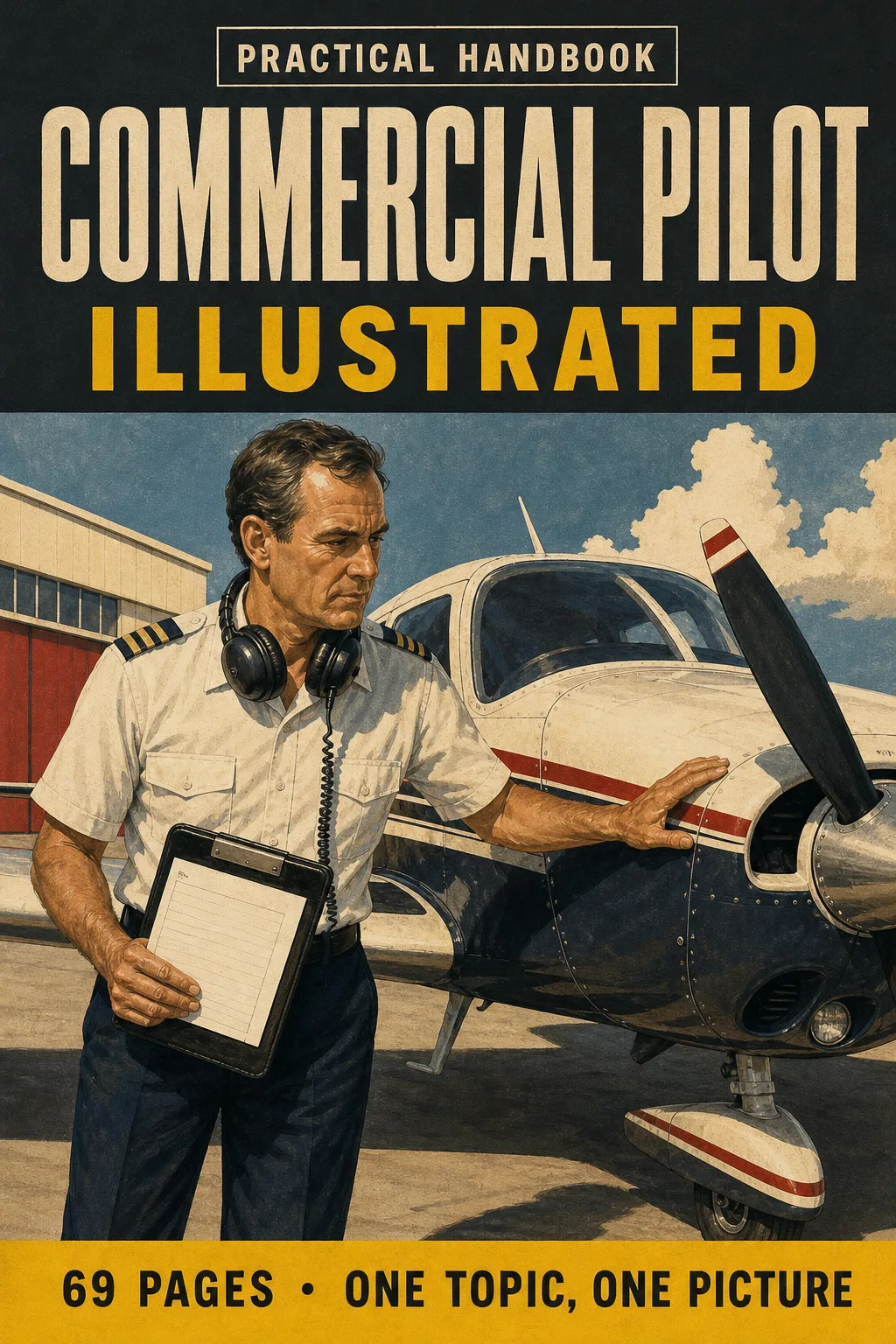
The FAA Commercial Knowledge Test in Drawings One Page per Topic, Ready for the Test and the Oral

The V-g diagram, the prop governor, performance charts, weight and balance, METARs and TAFs, VFR minimums, Part 135 rules and the chandelle. Every topic gets its own page: the drawing first, then what you need to remember. 69 illustrated pages.

START STUDYING THIS WAY

🔒 Secure checkout · PDF by email · 30-day guarantee

Every topic, its own pageEvery system and chart drawn, with the explanation right beside it
69 illustrated pages9 parts, from the Commercial certificate to test-day review
Up-to-date sourcesCommercial Pilot ACS, 14 CFR Parts 61, 91, 119 and 135, and FAA handbooks
PDF by emailFormat

Look Inside the Book

Every page has a big drawing and a box with the numbers, rules and steps you need to know:

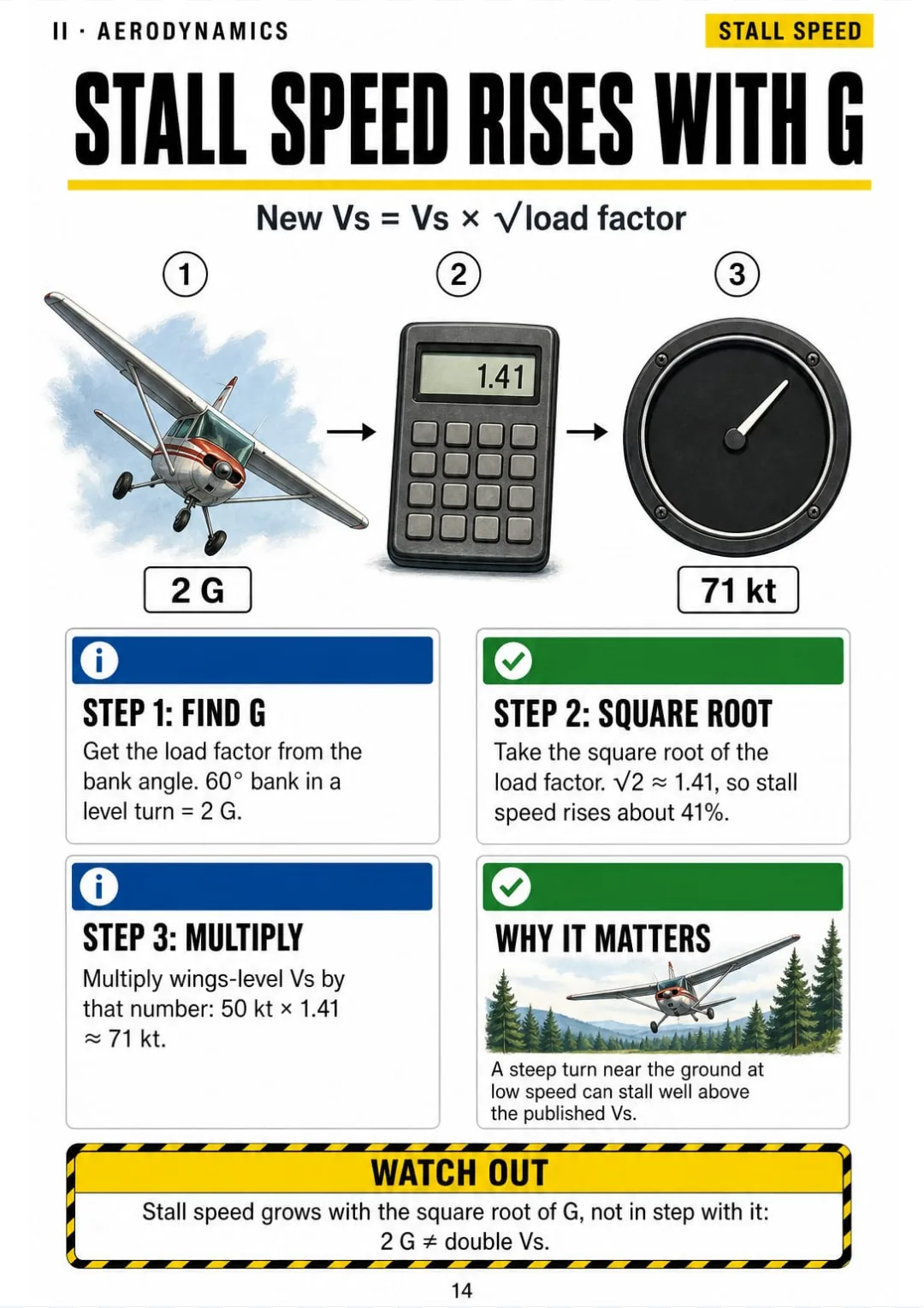
60° bank: Vs × √2 → 50 kt becomes about 71 kt
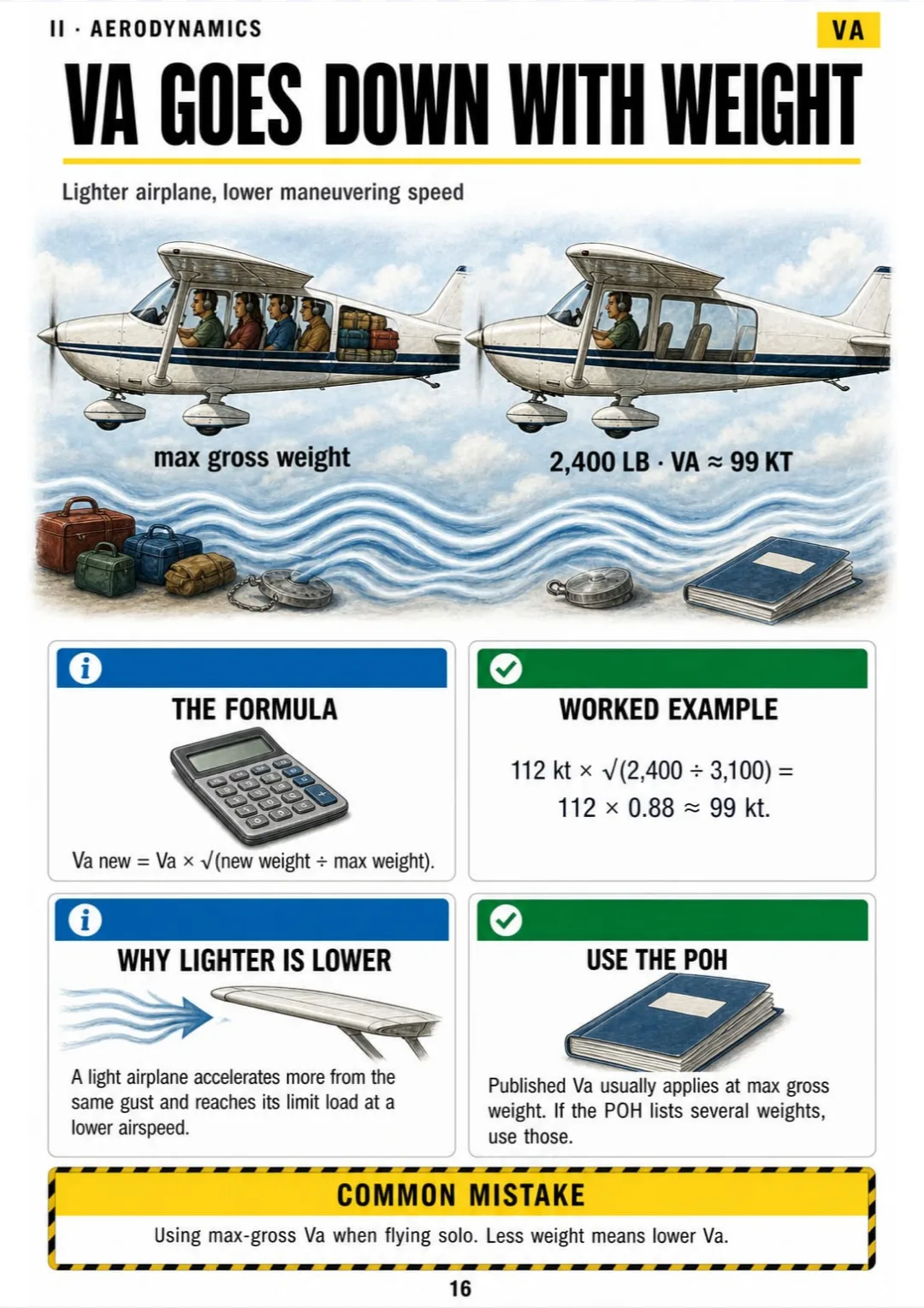
Va 112 kt at 3,100 lb becomes about 99 kt at 2,400 lb
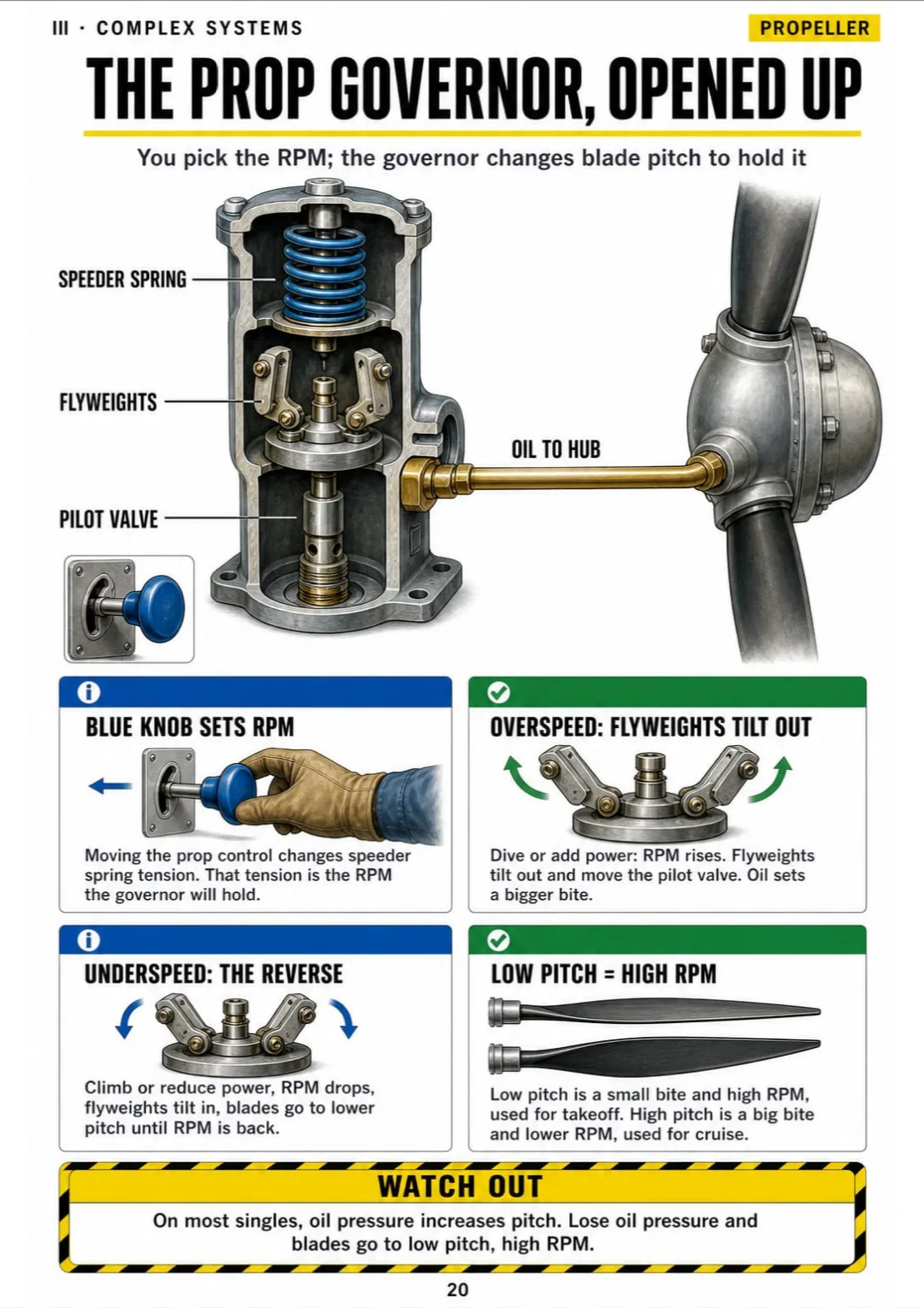
Prop governor cutaway: oil pressure loss on most singles means low pitch, high RPM
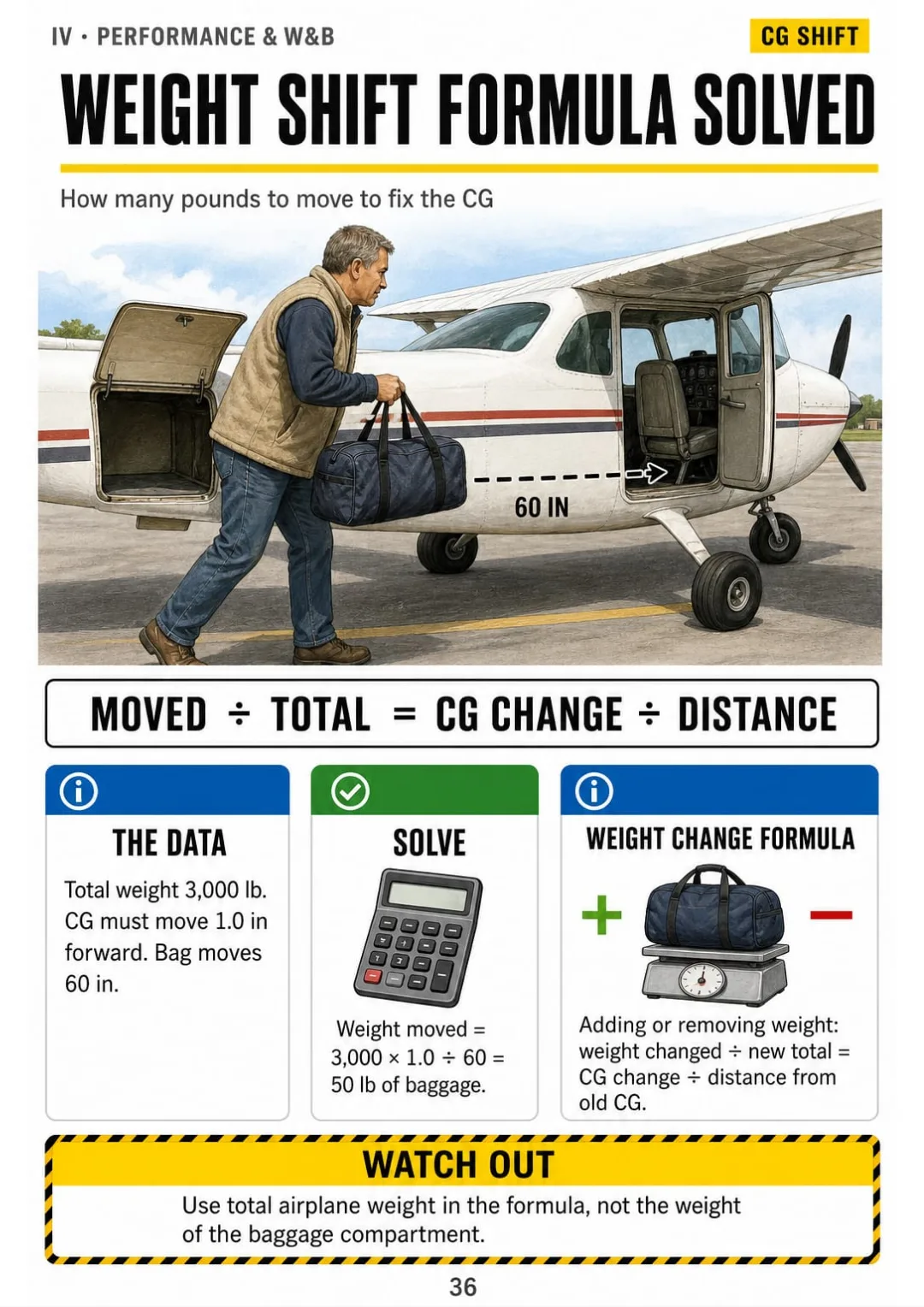
3,000 lb, 1.0 in CG change, 60 in move: shift 50 lb
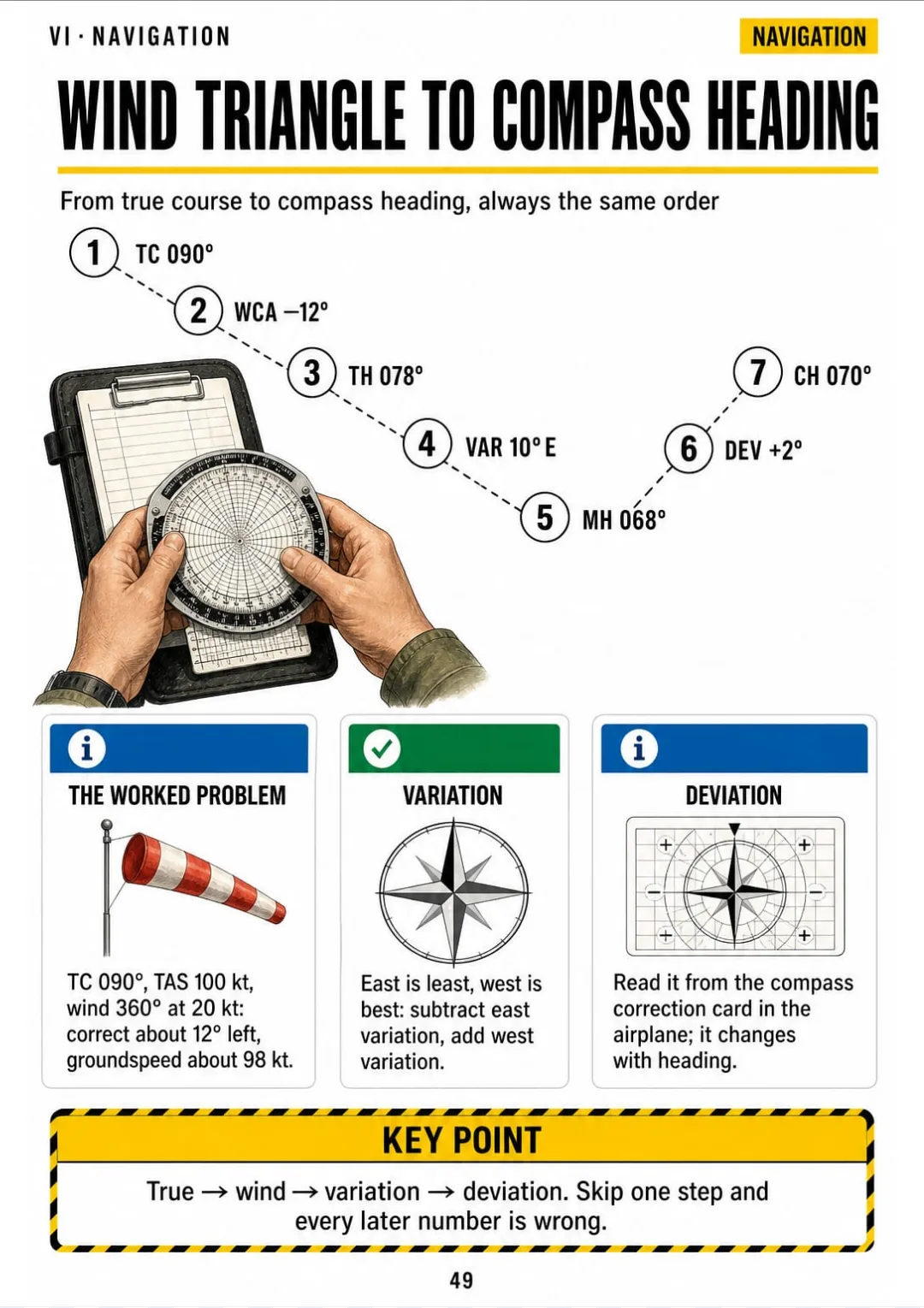
TC 090°, wind 360/20, TAS 100: TH 078°, MH 068°, CH 070°, groundspeed about 98 kt.
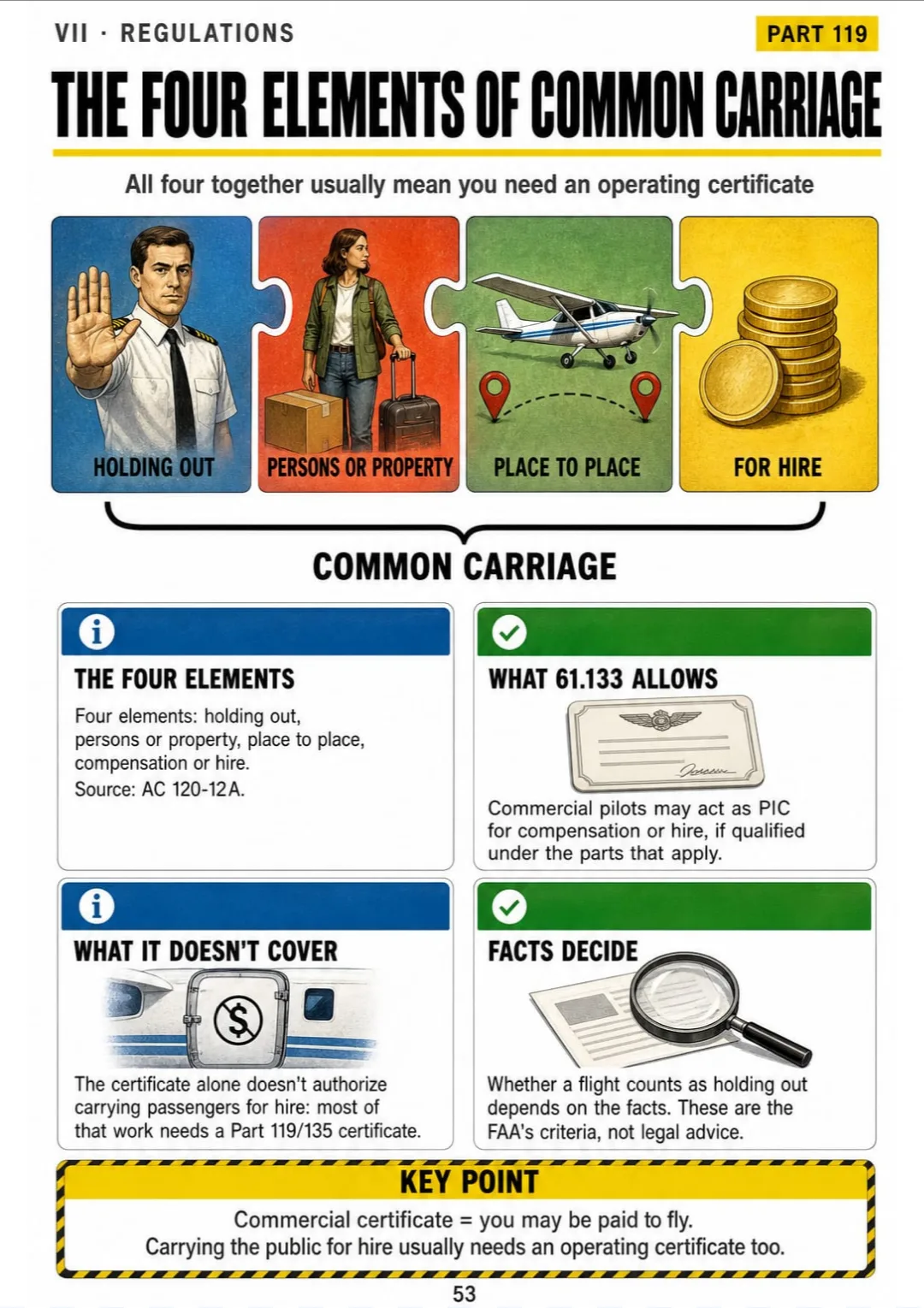
Holding out + persons or property + place to place + for hire = common carriage (AC 120-12A).
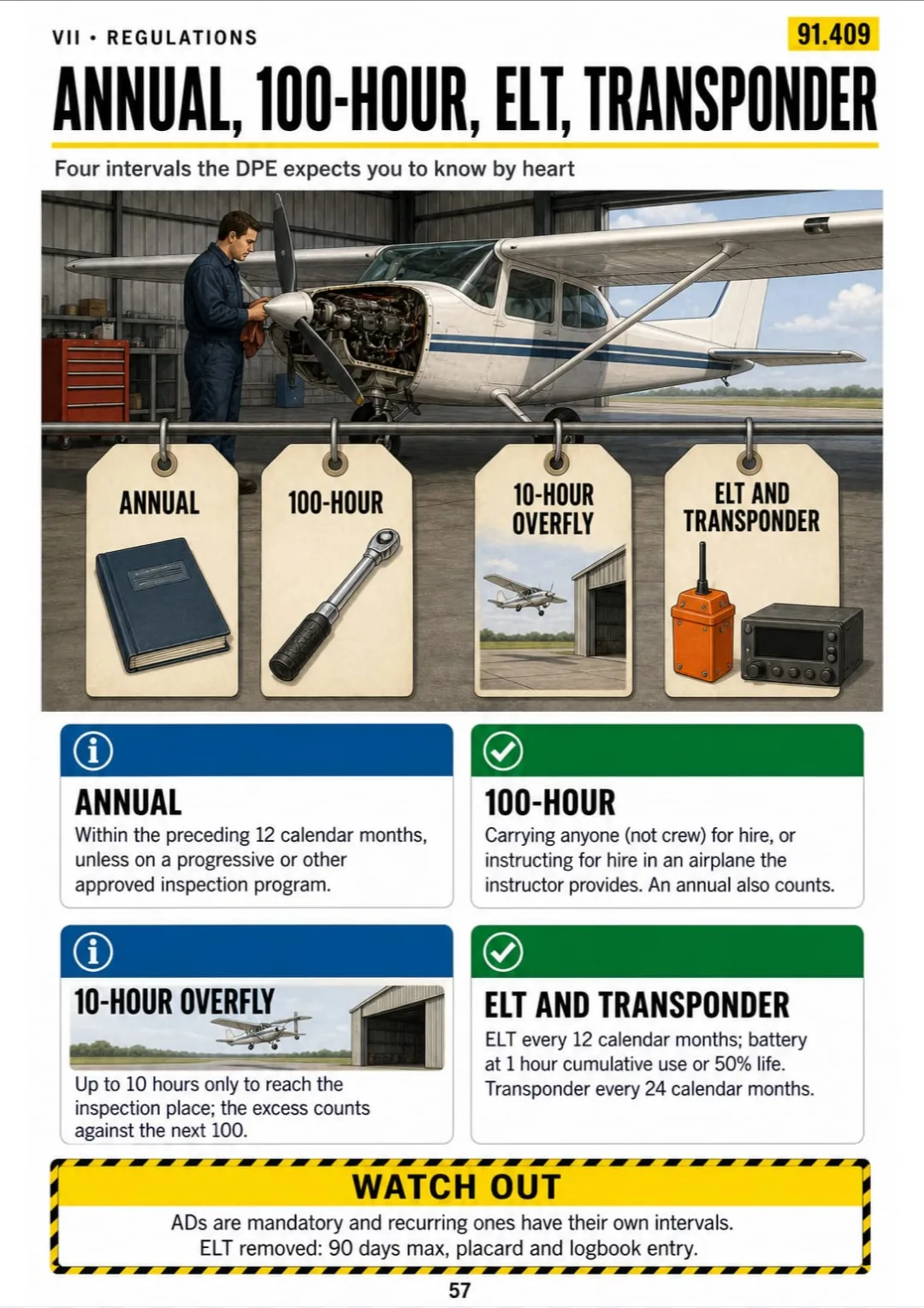
Annual 12 months · 100-hour for hire · ELT 12 months · transponder 24 months.
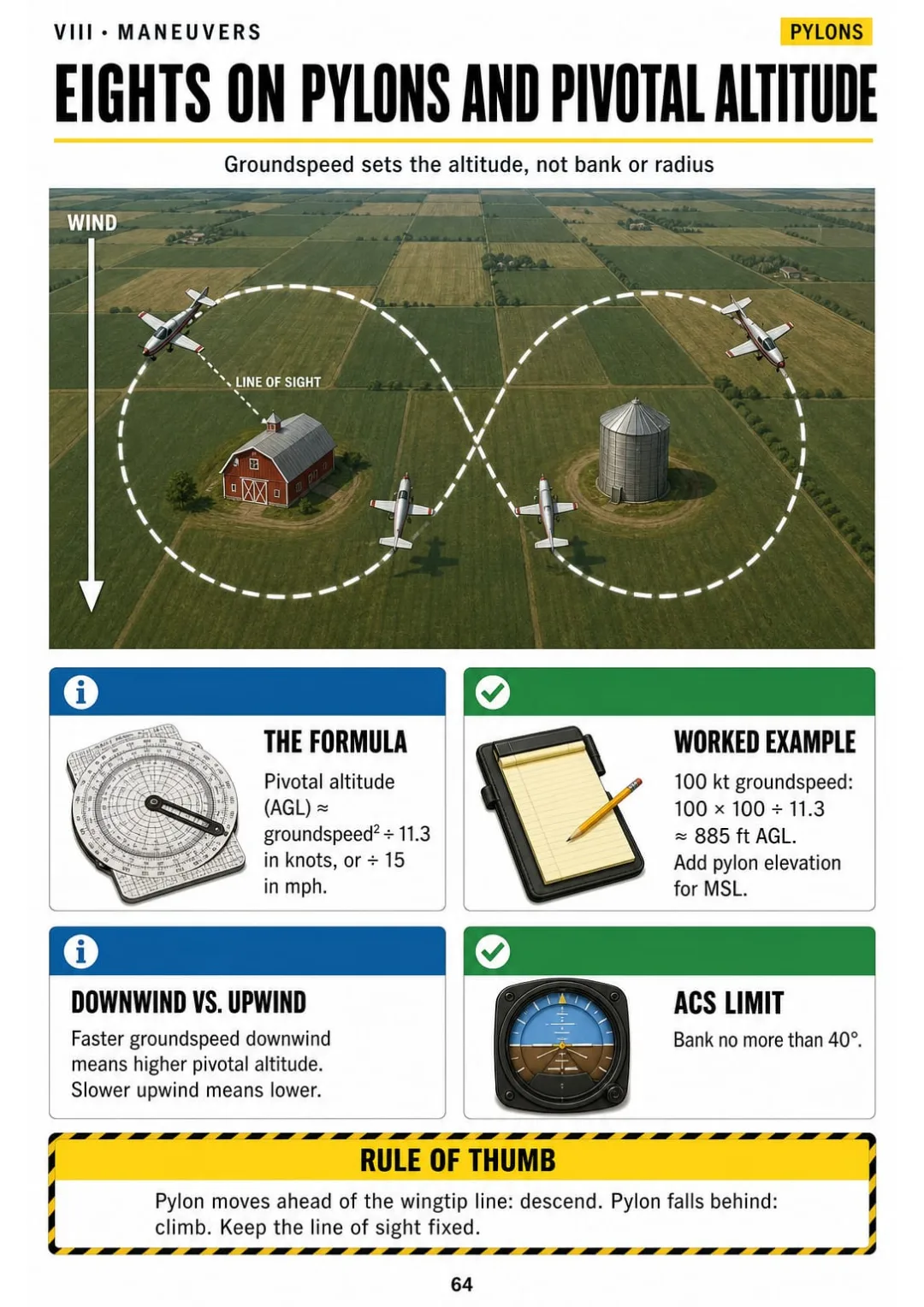
Pivotal altitude ≈ groundspeed² ÷ 11.3: 100 kt gives about 885 ft AGL.

Swipe to see more →

These are real pages from the book. The table of contents is the full one: 9 parts and 65 topics.

The Problem Isn't You. It's How It Was Explained to You.

It's 10 p.m., the app asks about the constant-speed prop: oil pressure drops, so what does the prop do? You've seen this answer before, and it's gone.

The handbook describes the governor in paragraphs: flyweights, speeder spring, pilot valve, oil, counterweights. Five moving parts, explained with words only. By the third paragraph you've lost which way the oil pushes.

Prop governor cutaway: oil pressure loss on most singles means low pitch, high RPM

In the book, the governor is cut open on one page. Flyweights, spring and pilot valve drawn in place, with the oil path in color. Next to it, one line in a box: on most singles, no oil pressure means low pitch, high RPM.

The rest of the complex airplane works the same way: the turbo and its wastegate, the retractable gear, the flaps, manifold pressure, the throttle-prop-mixture order. Each one has its own page.

So when the question comes back worded differently, or the DPE asks it out loud, you picture the governor and explain it without opening the handbook again.

COMPARE FOR YOURSELF

Same Topic, Two Ways to Study It

THIS
  • The handbook: line after line
  • The V-g diagram explained in words only
  • You walk into the test still unsure
The V-g diagram, or flight envelope, presents the relationship between indicated airspeed and load factor for a given aircraft. The curved lines originating at zero represent maximum lift capability, beyond which the wing stalls. The horizontal boundaries correspond to the positive and negative limit load factors, which for normal category airplanes are 3.8 and -1.52 G. The intersection of the positive stall line with the limit load factor defines maneuvering speed. The normal operating range extends to Vno, beyond which flight is restricted to smooth air, terminating at Vne.
FOR THIS
  • The V-g diagram in one drawing
  • Va, Vno and Vne in a box
  • You see it and it clicks
Va 112 kt at 3,100 lb becomes about 99 kt at 2,400 lb
CONTENTS

Take a Look at the 9 Parts and 65 Topics

The certificate, aerodynamics and the V-g diagram, complex systems, performance and weight & balance, weather, airspace and aeromedical, regulations, commercial maneuvers and a final review: 69 pages, all illustrated.

IThe Commercial Certificate · pp. 5-10
  1. From Private to Commercial: What Actually Changes
  2. The Knowledge Test (CAX) at a Glance
  3. The 250 Hours Mapped Out (61.129)
  4. Second-Class Medical: How Long It Lasts
  5. The 'No Instrument Rating' Limitation
  6. Endorsements You Will Need
IIAerodynamics and the V-g Diagram · pp. 11-19
  1. The Four Forces in a Climb, a Glide and a Turn
  2. Angle of Attack, Not Airspeed, Stalls the Wing
  3. Load Factor in a Turn
  4. Stall Speed Rises with Load Factor
  5. The V-g Diagram Drawn Line by Line
  6. Maneuvering Speed Goes Down with Weight
  7. Left-Turning Tendencies
  8. Stability: Static, Dynamic and the CG
  9. Ground Effect, Wingtip Vortices and Wake
IIIComplex and High-Performance Systems · pp. 20-28
  1. Constant-Speed Prop: The Governor
  2. Throttle, Prop, Mixture: Power Up vs. Power Down
  3. Manifold Pressure Read Correctly
  4. Turbocharger, Wastegate and Critical Altitude
  5. Retractable Landing Gear
  6. Flaps: Types and What They Do
  7. Fuel and Induction Systems
  8. Electrical System and Alternator Failure
  9. Pressurization and Supplemental Oxygen
IVPerformance and Weight & Balance · pp. 29-37
  1. Pressure Altitude and Density Altitude
  2. Reading Any Performance Chart in 5 Steps
  3. Takeoff Distance Chart Worked
  4. Climb, Cruise and Range Tables
  5. Landing Distance and Crosswind Charts
  6. Vx, Vy and the Speeds That Change with Altitude
  7. Weight and Balance in 4 Steps
  8. Weight Shift and Weight Change Formula
  9. Fuel Burn and the CG That Moves
VWeather for the Commercial Pilot · pp. 38-45
  1. Stability, Lapse Rate and Cloud Bases
  2. Fronts and Air Masses
  3. Thunderstorms: Three Stages and What They Need
  4. Icing and Fog
  5. METAR Decoded Line by Line
  6. TAF Decoded Line by Line
  7. GFA, AIRMETs and SIGMETs
  8. Wind Shear and Microbursts
VIAirspace, Navigation and Aeromedical · pp. 46-52
  1. VFR Weather Minimums in One Table
  2. Airspace Classes and Entry Requirements
  3. Special Use Airspace and Special VFR
  4. Wind Triangle and Pilotage in Order
  5. VOR, GPS and Lost Procedures
  6. Hypoxia, Disorientation and Fitness to Fly
  7. ADM: Hazardous Attitudes and Risk
VIIRegulations: Parts 61, 91, 119 and 135 · pp. 53-60
  1. Holding Out and Common Carriage
  2. What You Can Fly for Hire Without a 135 Certificate
  3. Currency: Flight Review, Takeoffs and Night
  4. Required Equipment: Day and Night VFR
  5. Inspections: Annual, 100-Hour and the Rest
  6. Fuel Reserves, Altitudes and Right-of-Way
  7. Documents, Logbooks and Pilot Records
  8. Accidents and Incidents: NTSB 830
VIIICommercial Maneuvers for the Oral and the Checkride · pp. 61-65
  1. Steep Turns at 50°
  2. Chandelle: Two Halves, Two Rules
  3. Lazy Eight: The Points That Matter
  4. Eights on Pylons and Pivotal Altitude
  5. Power-Off 180 and Steep Spiral
IXFinal Review Before Test Day · pp. 66-69
  1. Frequent Errors on Performance and W&B Questions
  2. Frequent Errors on Regulations
  3. Oral Prep: Explaining the Why to the DPE
  4. Test Day Checklist

One Page, One Topic, All Clear

Think of it this way:

The DPE puts a loading problem in front of you: 3,000 lb airplane, the CG has to move one inch forward, and you can move bags 60 inches, from the aft baggage area to the front seat. How much weight do you shift? He waits for the number and the why.

In the book you open the weight-shift page and the formula is drawn on the airplane, with that exact example solved step by step: 50 lb shifted, every number in its place.

TC 090°, wind 360/20, TAS 100: TH 078°, MH 068°, CH 070°, groundspeed about 98 kt.

Same with density altitude, the takeoff distance chart, the VFR minimums table, the chandelle and the four elements of common carriage: each one on its own page.

Commercial Pilot Illustrated is 69 illustrated pages in 9 parts, one topic per page, and it ends with the frequent errors on performance, W&B and regs, plus a test-day checklist.

What you see drawn, you don't have to memorize.

What's Inside Commercial Pilot Illustrated:

Ipp. 5-10

The Commercial Certificate

What changes from Private to Commercial, the knowledge test at a glance, the 250 hours of 61.129, the second-class medical, the no-instrument limitation and your endorsements.

IIpp. 11-19

Aerodynamics and the V-g Diagram

The four forces, angle of attack, load factor and stall speed in a turn, the V-g diagram line by line, maneuvering speed and weight, left-turning tendencies, stability and wake turbulence.

IIIpp. 20-28

Complex and High-Performance Systems

The constant-speed prop and its governor, the throttle-prop-mixture order, manifold pressure, turbo and wastegate, retractable gear, flaps, fuel, electrical, pressurization and oxygen.

IVpp. 29-37

Performance and Weight & Balance

Pressure and density altitude, any performance chart in 5 steps, takeoff, climb, cruise and landing charts, Vx and Vy, and weight and balance with weight shift and fuel burn.

Vpp. 38-45

Weather for the Commercial Pilot

Stability and cloud bases, fronts and air masses, thunderstorms, icing and fog, METAR and TAF decoded line by line, GFA, AIRMETs and SIGMETs, wind shear and microbursts.

VIpp. 46-52

Airspace, Navigation and Aeromedical

VFR minimums in one table, airspace classes and entry requirements, special use airspace and Special VFR, the wind triangle, VOR, GPS and lost procedures, hypoxia, disorientation and ADM.

VIIpp. 53-60

Regulations: Parts 61, 91, 119 and 135

Holding out and common carriage, what you can fly for hire without a 135 certificate, currency, required equipment, inspections, fuel reserves, logbooks and NTSB 830.

VIIIpp. 61-65

Commercial Maneuvers for the Oral and the Checkride

Steep turns, the chandelle, the lazy eight, eights on pylons and pivotal altitude, the power-off 180 and the steep spiral.

IXpp. 66-69

Final Review Before Test Day

Frequent errors on performance, W&B and regulations, how to explain the why to the DPE, and a test-day checklist.

At the end of the book: A final review of frequent errors on performance, W&B and regs, plus a test-day checklist.
Plus: 2 Free Books

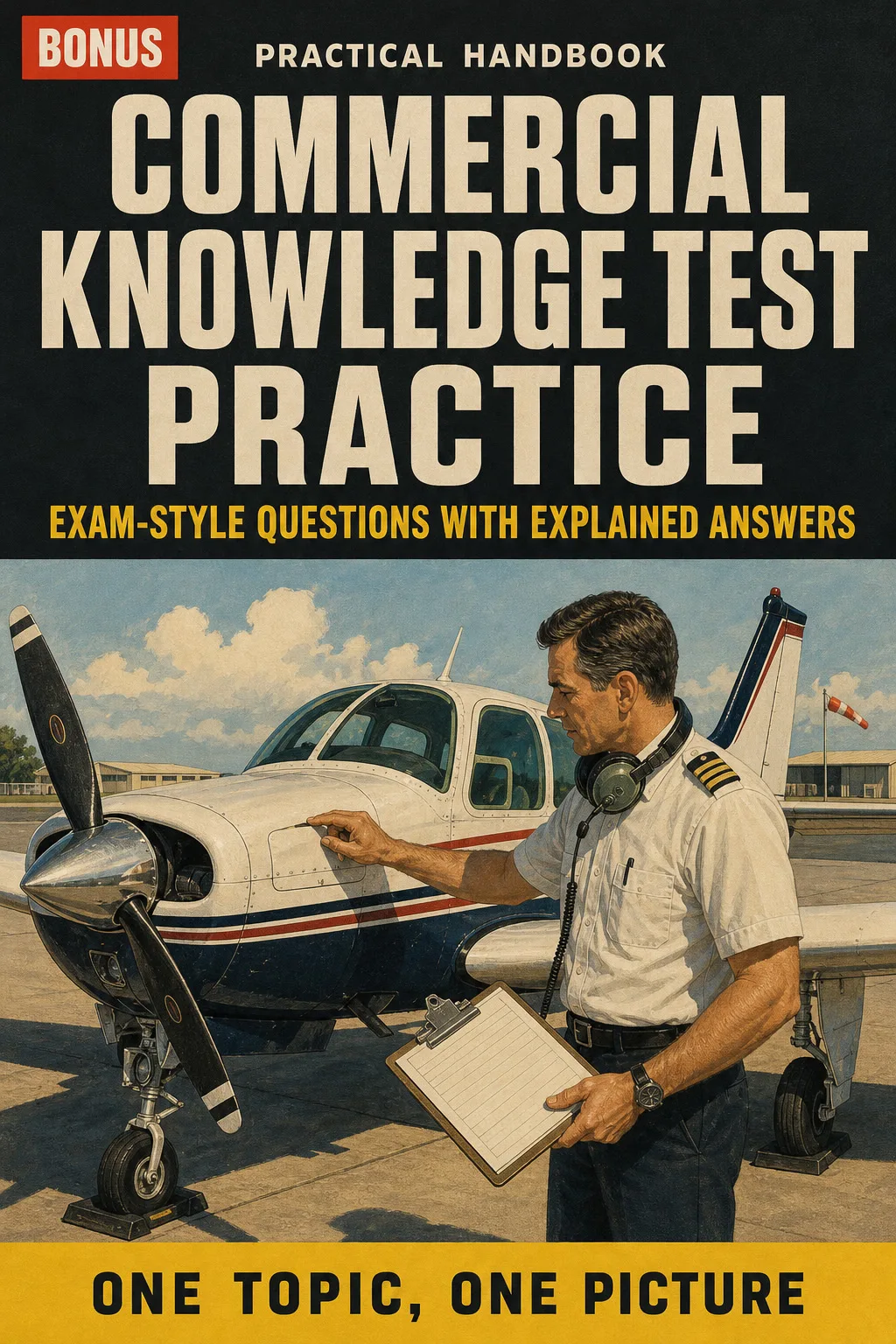
Commercial Knowledge Test Practice: Exam-Style Questions with Explained Answers

BONUS 1: «Commercial Knowledge Test Practice: Exam-Style Questions with Explained Answers»

Value on its own: US$ 17.90

Practice with questions in the style of the knowledge test and see why each answer is right, with the book page to review.

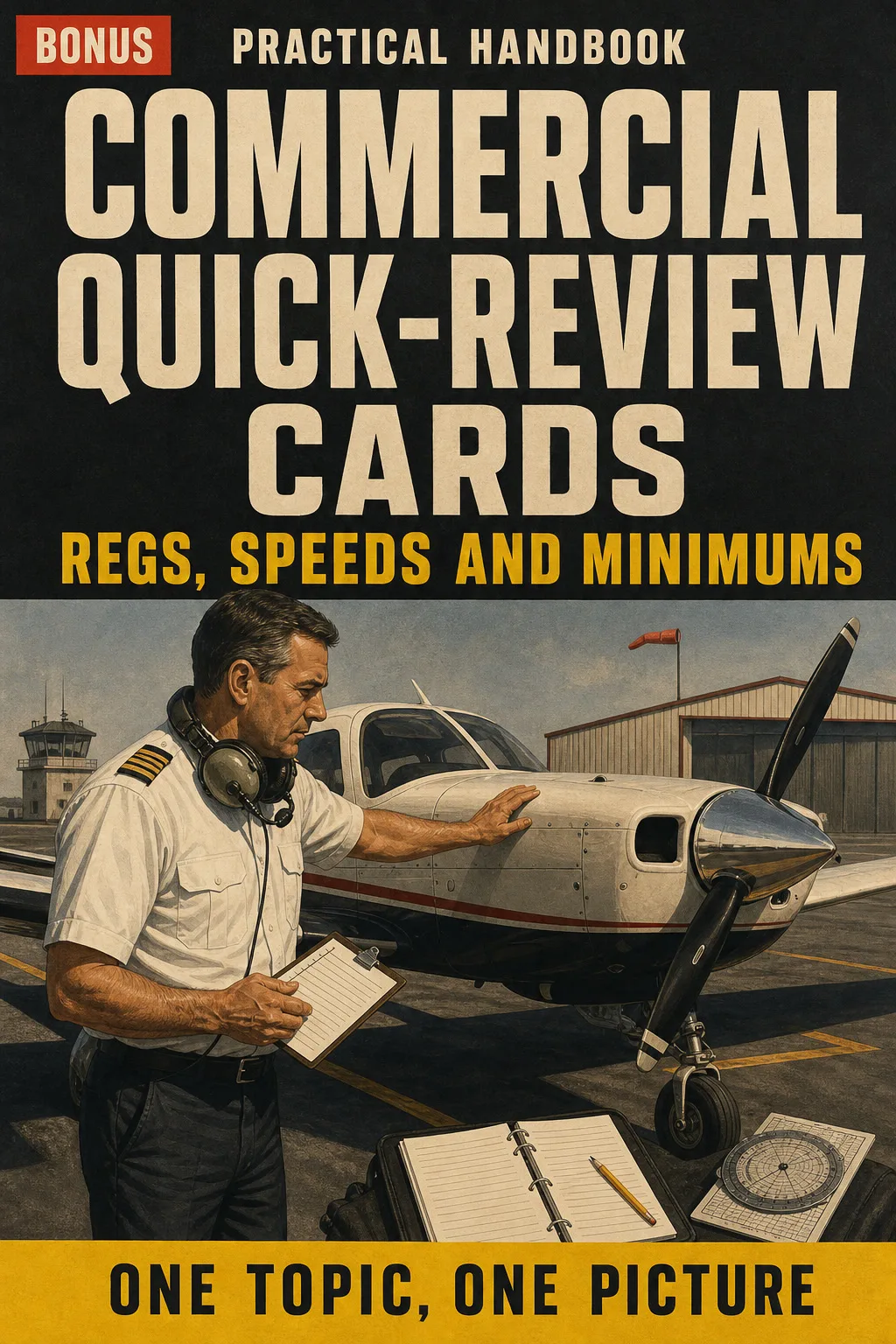
Commercial Quick-Review Cards: Regs, Speeds and Minimums

BONUS 2: «Commercial Quick-Review Cards: Regs, Speeds and Minimums»

Value on its own: US$ 14.90

The privileges, VFR minimums, required equipment and key speeds on printable cards, so you can review everything at a glance before the test and the oral.

Commercial Pilot Illustrated with 2 Free Books

  • Commercial Pilot Illustrated: 69 illustrated pagesUS$ 63
  • BONUS 1: Commercial Knowledge Test Practice: Exam-Style Questions with Explained AnswersUS$ 17.90
  • BONUS 2: Commercial Quick-Review Cards: Regs, Speeds and MinimumsUS$ 14.90
  • High-resolution PDF to printIncluded
Total value US$ 95.80
YOUR PRICE:
US$ 27
You save US$ 68.80
YES, I WANT COMMERCIAL PILOT ILLUSTRATED FOR US$ 27

📄 This is a digital PDF book sent to your email: nothing is printed or shipped.

Secure purchaseEncrypted payment30-day guarantee

PDF by email: We email you Commercial Pilot Illustrated as a PDF, together with the two free books. It's a single payment: no installments, no extra charges.

Who This Book Is For

You're studying for the knowledge test

You're studying for the knowledge test

Every topic of the CAX has its page, so after work you study one drawing at a time instead of memorizing app answers.

Your checkride is coming up

Your checkride is coming up

The V-g diagram, the governor and the common carriage rules drawn so you can explain the why to the DPE, not just recite it.

You already fly for hire

You already fly for hire

Regs, inspections, VFR minimums and performance charts on one page each, to print and keep in your flight bag or at the FBO.

Everything You Get Today

US$ 95.80US$ 27
YES, I WANT COMMERCIAL PILOT ILLUSTRATED FOR US$ 27

📄 This is a digital PDF book sent to your email: nothing is printed or shipped.

30DAYS
GUARANTEE

30-Day Guarantee

Try Commercial Pilot Illustrated for 30 days, bonus books included.

We refund everything if the file won't open, if the book isn't what you see here, if you were charged twice or if the email doesn't arrive. Just email us.

You pay once. No subscriptions.

Frequently Asked Questions

Is it for me if I got my Private years ago and I'm coming back to go for the Commercial?

Yes. It starts from what changes between Private and Commercial and goes straight to the Commercial topics: the V-g diagram, complex systems, performance, W&B, weather, Parts 61, 91, 119 and 135, and the maneuvers.

Where does the content come from?

It's checked against the current FAA Commercial Pilot for Airplane Category ACS (FAA-S-ACS-7B), 14 CFR Parts 61, 91, 119 and 135 as currently published in the eCFR, the Pilot's Handbook of Aeronautical Knowledge (FAA-H-8083-25) and the Airplane Flying Handbook (FAA-H-8083-3).

Is this official FAA material?

No. It's an independent illustrated study book. It's not published, approved or endorsed by the FAA.

Does it replace my CFI or ground school?

No. It's study material that sits next to your training. It doesn't give you the endorsement you need to take the knowledge test or the checkride: that still comes from your CFI or your ground school. It doesn't replace your instructor, the POH/AFM or current charts, and it's not for real-world navigation: charts and W&B examples are for study only.

Are the practice questions the ones on the real test?

No. They're exam-style questions written for this book, with explained answers. The FAA's test bank isn't public.

When and how do I get it?

The book and the 2 bonus books come as a PDF by email, to the address you enter at checkout. It's a one-time payment, no subscription.

I already have a question-bank app and a video course. Why a book?

Keep them. The app tells you if an answer is right; the book shows you why, on one page you can find again. When the question comes worded differently, or the DPE asks it out loud, you picture the governor, the V-g diagram or the weight-shift drawing instead of hunting for a memorized answer. And unlike a video, you can flip to the page in ten seconds the night before the oral.

Can I have it on paper?

It's a PDF, not a shipped book. Read it on your iPad or tablet, or print it at home or at a print shop and keep the pages you need in your flight bag or at the FBO.

How does the refund work?

You have 30 days. We refund everything if the file won't open, if the book isn't what you see on this page, if you were charged twice or if the email doesn't arrive: just email us.

Before You Close This Page

No more rereading without anything sticking.

The V-g diagram: you see it drawn and you've got it.

You walk into the test and the oral knowing where everything is.

Drawings make studying faster.

The book is right below.

One-time payment: US$ 27 · Guarantee: 30 days · PDF by email

YES, I WANT COMMERCIAL PILOT ILLUSTRATED FOR US$ 27

📄 This is a digital PDF book sent to your email: nothing is printed or shipped.